
Production Grade SiC Crystal vs Dummy Grade SiC Crystal: Application Differences
Silicon carbide (SiC) has become one of the most important wide bandgap semiconductor materials for next-generation power electronics, electric vehicles, renewable energy systems and high-frequency devices.
During SiC crystal manufacturing and semiconductor process development, two types of materials are commonly used:
Production Grade SiC Crystal
Dummy Grade SiC Crystal
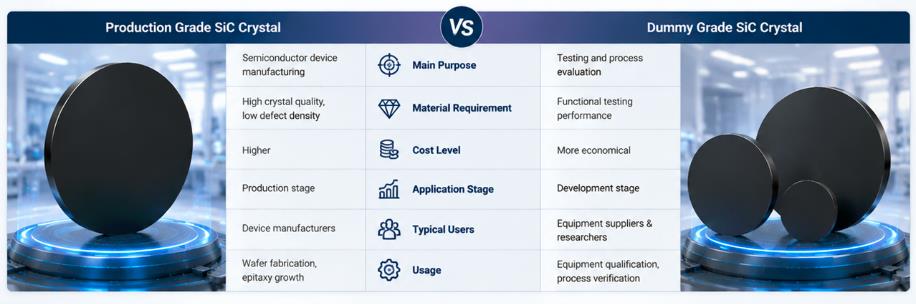
Although both are based on high-quality silicon carbide single crystal materials, they serve different purposes in semiconductor manufacturing.Production grade SiC crystals are mainly designed for wafer fabrication and device manufacturing, while dummy grade SiC crystals are optimized for equipment testing, process verification and research applications.
Understanding the differences between these two SiC crystal types helps semiconductor companies select the right material for their specific requirements.
What Is Production Grade SiC Crystal?
Production Grade SiC Crystal refers to high-quality silicon carbide single crystal material developed for semiconductor device manufacturing.
These crystals require strict control of:
a. Crystal quality
b. Defect density
c. Electrical properties
d. Crystal orientation
e. Material consistency
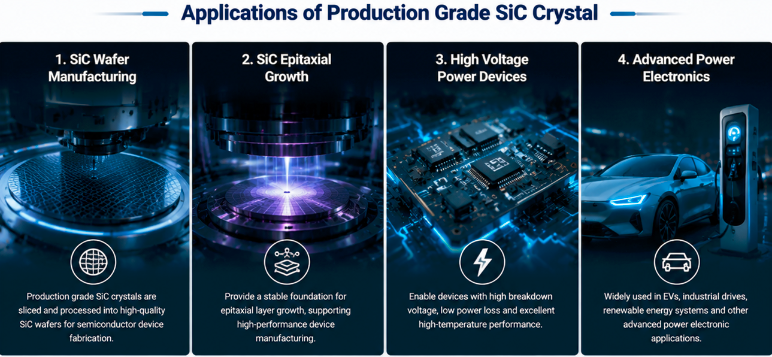
Production grade SiC crystals are typically processed into SiC wafers and substrates for advanced semiconductor devices.
Common applications include:
* SiC MOSFET manufacturing
* Schottky diode production
* Power module fabrication
*SiC epitaxial wafer growth
For customers requiring semiconductor-grade materials, HMT provides Production Grade SiC Single Crystal solutions with different sizes including 2 inch, 4 inch and 6 inch SiC crystal materials.
What Is Dummy Grade SiC Crystal?
Dummy Grade SiC Crystal is a silicon carbide material mainly used for testing, process development and equipment qualification.
Unlike production grade materials, dummy grade SiC crystals are not primarily intended for final semiconductor device fabrication.
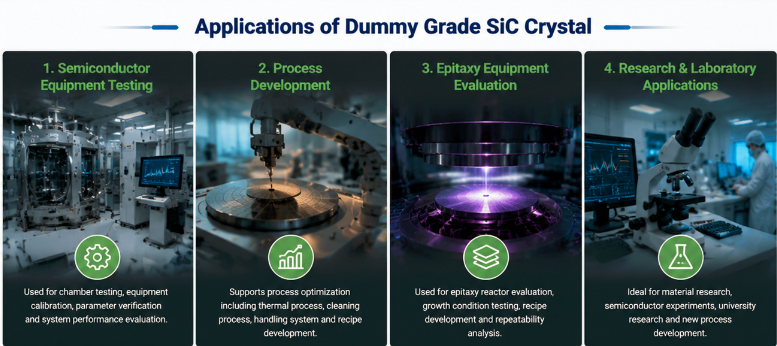
Instead, they provide a cost-effective platform for:
a. Semiconductor equipment testing
b. Process optimization
c. Manufacturing evaluation
d. Laboratory research
Dummy grade SiC crystals allow engineers to test semiconductor processes without consuming expensive production-grade materials.
For more information about dummy grade SiC crystal solutions.
Key Differences Between Production Grade and Dummy Grade SiC Crystal
| Comparison | Production Grade SiC Crystal | Dummy Grade SiC Crystal |
|---|---|---|
| Main Purpose | Semiconductor device manufacturing | Testing and process evaluation |
| Material Requirement | High crystal quality | Functional testing performance |
| Cost Level | Higher | More economical |
| Application Stage | Production stage | Development stage |
| Typical Users | Device manufacturers | Equipment suppliers & researchers |
| Usage | Wafer fabrication | Equipment qualification |
How to Select the Right SiC Crystal?
The selection depends on the application stage.
Choose Production Grade SiC Crystal when:
1. Manufacturing semiconductor devices
2. Producing SiC wafers
3. Growing high-quality epitaxial layers
Choose Dummy Grade SiC Crystal when:
1. Testing semiconductor equipment
2. Developing processes
3. Performing laboratory experiments
4. Optimizing manufacturing conditions
Conclusion
Production Grade SiC Crystal and Dummy Grade SiC Crystal play different but complementary roles in the semiconductor industry. Production grade materials focus on high-performance semiconductor manufacturing, while dummy grade materials provide an economical and reliable solution for testing, development and process qualification.
By selecting the appropriate SiC crystal material, semiconductor manufacturers can improve development efficiency, reduce costs and accelerate next-generation SiC device innovation.
 Homray Material Technology. All rights Reserved.
 E-mail:kim@homray-material.com;tina@homray-material.com